Sheet PL-120 · London, Ontario
Pool Liner Replacement in London, Ontario
A new inground vinyl liner, measured to your pool, set tight and filled.
This page is the whole job in plain words: how to tell your liner is done, how a new one is measured, what happens each day, when to book around opening and closing, and why the deck and coping are worth looking at while the pool is empty.
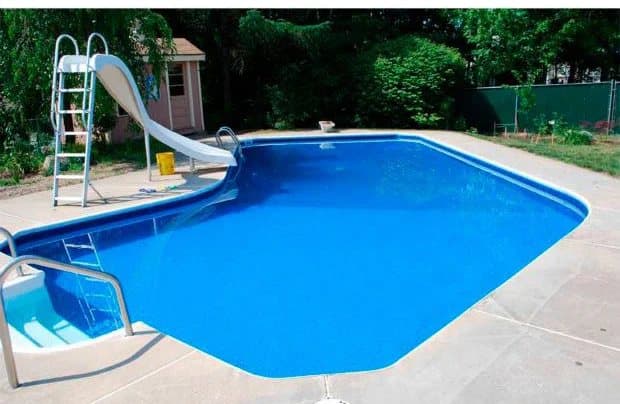
One Crew
Liner, coping and concrete deck, drained and filled once.
Liner life
Most vinyl liners last 8 to 12 years
On site
Usually 2 to 3 days once the liner arrives
Best time
Fall at closing, or spring at opening
Spec 01 · Signs it is time
Six signs your liner is near the end.
One of these alone can be age. Two or three together, on a liner past eight years old, usually means replace rather than repair.
Sign 01
Fading and chalky vinyl
The pattern above the waterline goes pale or white and the vinyl feels chalky. That is UV and chlorine breaking down the plasticizers that keep it soft.
Sign 02
Brittle at the waterline
Press the vinyl at the waterline and in the corners. If it feels stiff, cracks, or splits when you push it, the liner is near the end, even if it still holds water.
Sign 03
Losing water
More than about a quarter inch a day that is not weather. Do the bucket test below first so you know it is a leak and not just a hot, windy week.
Sign 04
Wrinkles that stay
Small wrinkles after a fill can relax. Wrinkles that grow every season mean the vinyl has stretched or water is getting behind it.
Sign 05
Liner pulling out of the track
The bead at the top slipping out of the coping track, usually on the sunny side. Old vinyl shrinks, and once it pops out it rarely goes back for good.
Sign 06
Rust, stains or bumps behind it
Brown stains or soft spots behind the liner can mean the walls or the floor underneath need work. Better to find that with the old liner out than after a new one goes in.
Leak or weather? The bucket test
- Set a bucket on the second step, fill it to the same level as the pool, and mark both water lines.
- Run the pump as normal for 24 hours. Do not top up.
- If the pool dropped more than the bucket, you are losing water to a leak, not to sun and wind.
- Repeat with the pump off. A bigger drop with the pump on points at the plumbing; the same drop either way points at the liner.
What shortens a liner's life
- Low pH and very high chlorine, which bleach and stiffen the vinyl.
- Shock or tablets dropped straight onto the floor instead of dissolved first.
- A pool left too low over winter, so the vinyl dries, shrinks and pulls out of the track.
- Sharp toys, pool cleaners with worn parts, and pets' claws.
- Groundwater and freeze and thaw working on a leak that was left for a season.
Spec 02 · Measuring
A liner only fits if the pool was measured, not guessed.
An inground liner is made to the exact shape of one pool. Pools move over the years: walls lean a little, corners shift, the floor settles. A liner cut to the original drawing or the old liner's tag can come out loose, with wrinkles, or too tight, pulling at the corners and steps.
What gets measured:
- The perimeter at the track, and fixed points across the pool to lock in the true shape.
- Depths along the floor: shallow end, where the slope breaks, and the deep end.
- Steps, benches and swim-outs, and where they sit on the walls.
- The type of track or coping the liner hangs from, and whether it is still sound.
- Where every fitting is: returns, skimmer, lights and the main drain.
Spec 03 · The vinyl
Choosing the liner.
Thickness: ask for mil
Thicker vinyl stands up better to punctures, cleaners and wrinkles. Get the number in mil in writing. Some liners are sold by gauge, which is not the same measure; a liner quoted by gauge is often thinner than the same number in mil.
How it hangs
Most inground pools here use a beaded liner that clips into a track under the coping. The new liner must match the track you have, or the track gets replaced with the coping.
Pattern
Pick from real samples, held up in your own yard. Darker and busier patterns hide wear and debris; a tile border at the waterline hides the scum line.
Steps
Vinyl-covered steps take the most wear in the pool, so they usually get heavier vinyl than the walls.
Spec 04 · The job, day by day
From first visit to first swim.
Most swaps are two to three days on site once the liner arrives. We keep the time the pool sits empty as short as we can, because an empty vinyl pool is at its most fragile.
-
Visit 1
Look, measure, quote
We check the liner, the coping and track, the deck and the water level, then measure the pool itself, not an old drawing. You pick the pattern and get one written quote.
-
Lead time
Your liner gets made
Every inground liner is made to order from the measurements. Lead time depends on the manufacturer and the season; spring is the busiest. We give you the install date once the liner is ordered.
-
Day 1
Drain and pull
The water comes down, faceplates and fittings come off, and the old liner is cut out and hauled away. We plan where the water goes before we start.
-
Day 1 to 2
Inspect and prep the shell
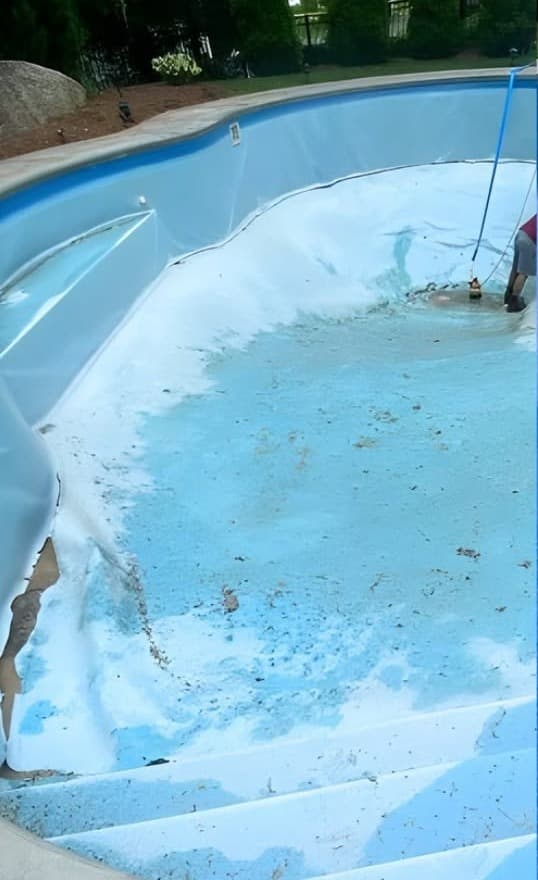
With the liner out we see everything: wall panels, rust, the floor, the corners and the track. Floor gouges get patched and smoothed so nothing shows through the new vinyl. Anything bigger is shown to you, with options, before we go on.
-
Day 2
Set the new liner
The liner goes in, the bead is locked into the track all the way around, and a vacuum behind the wall pulls the vinyl tight to the walls and floor. Wrinkles are worked out by hand before any water goes in.
-
Day 2 to 3
Fill and cut in
The pool fills by hose or water truck. As the water rises past each fitting (returns, skimmer, lights, main drain) it is cut in with new gaskets and faceplates so it seals against the new vinyl.
-
Last
Start-up and walkthrough
The pool is brought up to level, the equipment runs, and we walk the finished pool with you before we call it done.
Spec 05 · Timing in London
Plan it around opening and closing.
Vinyl goes in best in mild weather: soft enough to stretch into the corners, not so hot it over-stretches. In London that points at fall closing, with spring opening as the second choice.
Best
Fall, at closing
The pool is coming down anyway. The new liner goes in, the pool is refilled to winter level and closed, and you open next spring with a pool that is ready to swim.
Book
Winter
No installs in a London winter, but this is when to book. Spring slots go to whoever measured first.
Good
Spring, at opening
Opening is when most failed liners get found. Fine timing if you are on the list early; the later you call, the more swim days you lose.
Possible
Mid summer
It works, but you give up swimming in the best weeks, and on very hot days vinyl stretches and has to be set carefully.
Found a leak at closing? Do not drain the pool lower to "save" it over winter. Keep the water at winter level and book the replacement; a vinyl pool sits safest full.
Spec 06 · Liner + deck in one job
The pool is empty once. Fix what is around it too.
Most pool companies change liners. We are concrete contractors who also change liners, so a cracked deck, loose coping or a track that will not hold a bead is not a separate job with a separate trade. The order matters:
- Drain, pull the old liner, and take out the failing deck and coping.
- Repair the walls and set the new track to the new coping height.
- Pour the coping and deck on a compacted base, sloped away from the water, and let it cure.
- Liner in last, so no concrete work happens over new vinyl.
- One fill, one start-up, one walkthrough.
More on the concrete side: concrete pool decks in London. If the deck is sound, we tell you, and only the liner changes.
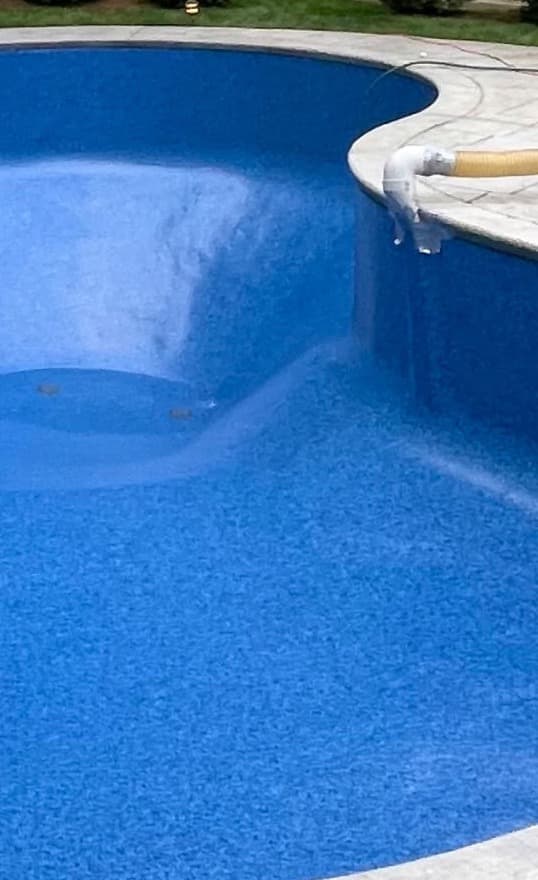 Before After
Spec 07 · Comparing quotes
Ask every liner company these eight things.
Liner quotes look alike until you line them up. These are the items that change the real cost and how long the liner lasts. Our written quote answers all of them.
- Liner thickness in mil, in writing, for the walls, floor and steps.
- Who measures, and whether they measure your actual pool.
- What happens if the walls, floor or track need work once the old liner is out.
- New gaskets and faceplates included, or extra.
- Old liner removal and disposal included.
- Where the water comes from for the fill, and who pays for it.
- Whose warranty covers what: the liner maker covers the vinyl, the installer covers the install.
- Whether the coping and deck around the pool are in good enough shape to keep.
Spec 08 · Pool liner questions
Asked before every liner quote.
How long does a pool liner last in London, Ontario?
Most vinyl liners last 8 to 12 years here. Balanced water, keeping the level right over winter and a good cover stretch that; low pH, shock poured straight onto the vinyl and a pool left too low all winter shorten it.
How long does a liner replacement take?
The liner itself is made to order, so there is a wait after measuring. Once it arrives, most swaps are two to three days on site, plus the time to fill. Repairs to the walls or floor, or a new deck and coping, add time.
Can I patch the liner instead of replacing it?
A small hole or tear in a liner that is still soft can be patched, even underwater. If the vinyl is brittle, faded and leaking in more than one spot, a patch only buys a few weeks and the next leak is usually close by.
Can I drain my pool myself to save time?
Please do not. An empty vinyl pool can be damaged quickly: the old liner shrinks and tears, groundwater can push the floor up, and walls can move. Leave the drain to the crew that is putting the new liner in the same day.
Can you reuse the old liner once the pool is drained?
Almost never. An older liner shrinks as soon as it is out of the water and in the air, and it will not go back on the walls without tearing. Plan for a new liner whenever an old pool has to be fully drained.
What thickness should my new liner be?
Thicker vinyl resists punctures and wrinkles better; many owners choose a thicker liner for the walls and floor and heavier vinyl over vinyl-covered steps. Ask for the thickness in mil. Some sellers quote gauge, and a liner sold by gauge is often thinner than the same number in mil.
Should I replace the coping and deck at the same time?
If the deck is cracked or heaving or the coping is loose, yes. Doing them together means one drain and one fill, and the new track, coping and liner all line up. If the deck is sound, we tell you and only change the liner.
Do I need a permit to replace a pool liner in London?
A liner swap on an existing pool usually does not need a building permit, but the pool fence and gate rules still apply during and after the work. Changes to the pool enclosure or a new raised deck can need City approval; we confirm what applies to your yard at the site visit.
See all our pool work, or the concrete driveways we pour with the same crew. Outside London? We also work in St. Thomas.